North East's landmark space centre reaches major construction milestone
Topping out ceremony marks pivotal moment for centre backed by £50 million investment set to transform the region's space economy.

Topping out ceremony marks pivotal moment for centre backed by £50 million investment set to transform the region's space economy.
A medical device company spun out of Northumbria University has reached a significant milestone — receiving CE marking for a breath sampling platform that peer-reviewed research has demonstrated can reliably collect saliva-free exhaled breath condensates (EBC) from the deep lung, making it the first technology of its type to achieve this distinction.

Researchers at Northumbria University have used the most powerful space telescope ever built to answer one of the longest-standing puzzles in planetary science – why does Saturn appear to spin at a different speed depending on how you measure it?

A Northumbria University academic who has played a key role in bringing breakfast clubs and holiday activities to millions of children across the country has been elected to the Fellowship of the Academy of Social Sciences.

A North East school has partnered with solar and space physics experts from Northumbria University for a project supported by a Royal Society Partnership Grant which aims to bring academic research and STEM careers to life.

An international team of scientists, led by a PhD researcher from Northumbria University, has made groundbreaking discoveries about a spectacular feature of Jupiter’s northern lights, revealing a never-before-seen temperature structure and dramatic density changes within the top of the giant planet’s atmosphere.

A new analysis of decades of research on the Antarctic Peninsula, involving experts from Northumbria University, concludes that the next ten years of climate action will decide Antarctica’s future for centuries to come.

A Northumbria University PhD student has led an international team of astronomers in creating the first-ever three-dimensional map of Uranus's upper atmosphere, revealing how the ice giant's unusual magnetic field shapes spectacular auroras high above the planet's clouds.
Using the James Webb Space Telescope, led by NASA with its partners, ESA (European Space Agency) and CSA (Canadian Space Age

Northumbria University researchers have joined forces with the International Federation of Red Cross and Red Crescent Societies (IFRC) to deliver the third edition of the IFRC Limitless Youth Innovation Leadership Academy—a programme which has already reached thousands of young people across 150 countries with the aim of driving youth innovation.

A Northumbria University graduate has developed groundbreaking AI technology that could save thousands of lives by speeding up the timescales of cardiovascular diagnosis. It is a deeply personal passion for Jack Parker, founder of AIATELLA, as his father suffered a heart attack while waiting for his scan to be read – exactly the problem he aims to solve through rapid, accurate diagnosis using AI.

The North East Space Communications Accelerator (NESCA) has successfully awarded its first round of innovation funding, distributing almost £340,000 across seven cutting-edge space communications and technology projects.

Research led by polar scientists from Northumbria University has revealed new hope in natural environmental systems found in East Antarctica which could help mitigate the overall rise of carbon dioxide in the atmosphere over long timescales.

Pioneering research launches in Leeds to test new approach to assessing the risk to children from hidden lead exposure.

Melt from ice sheets on Earth is already contributing to flooding across the globe and is expected to increase in the coming decades. Adaptation to reduce the destructiveness of future sea level rise is under way and depends critically, inch by inch, on the work of a newly-funded, international group of polar scientists.

Researchers have achieved a breakthrough in solar physics by providing the first direct evidence of small-scale torsional Alfvén waves in the Sun's corona – elusive magnetic waves that scientists have been searching for since the 1940s.

Equipment developed by researchers at Northumbria University, in collaboration with key industry partners, to improve the health and fitness of astronauts has received further research funding after being used in space for the first time.

Researchers from an outreach group at Northumbria University are celebrating after winning a prestigious 2025 Institute of Physics (IOP) award recognising their work with children and young people across the North East and beyond.

A study of Saturn's atmospheric structure using data from the James Webb Space Telescope (JWST) has revealed complex and mysterious features unseen before on any planet in our Solar System. The results were presented last week by Professor Tom Stallard of Northumbria University, at the EPSC-DPS2025 Joint Meeting in Helsinki.

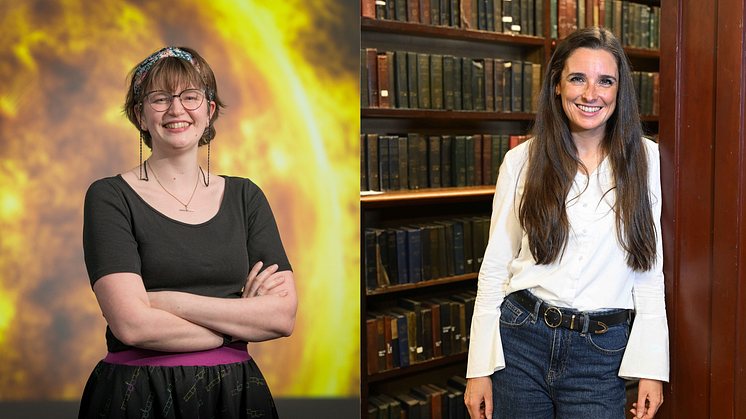
Two talented researchers from Northumbria University have been awarded a share of £120 million from UK Research and Innovation’s (UKRI) flagship Future Leaders Fellowship fund to help advance their work in space physics and book history.
Researchers in Vietnam, Thailand, India and the UK have been awarded more than £4 million by the National Institute for Health and Care Research (NIHR) to identify and evaluate inclusive methods of healthcare provision.
