Press release —
Global report on volunteer measurement supported by Northumbria researchers is launched
One year after Northumbria University was announced as the lead research partner on the 2026 State of the World's Volunteerism Report (SWVR) produced by United Nations Volunteers (UNV), the publication has been launched in New York on International Volunteer Day, 5 December.
The flagship United Nations report, designed to strengthen global understanding of volunteering, offers the most comprehensive analysis yet of the global scale and impact of volunteer work. The 2026 SWVR report “Volunteerism and its Measurements”was launched by UNV’s Executive Coordinator Toily Kurbanov during the opening event of the International Year of Volunteers for Sustainable Development (IVY) 2026, at the United Nations (UN) General Assembly in New York.
The SWVR 2026 tackles persistent evidence gaps that have limited understanding of the impacts of volunteering over time. The comprehensive eight-chapter report explores why and how to measure volunteering, provides updated global estimates of volunteer work, and examines how volunteering contributes to development outcomes, individual wellbeing and responses to multiple crises.
The report reveals that 34.5 per cent of working-age people – 2.1 billion individuals – engage in volunteer work each month globally, highlighting the unprecedented scale of the contribution volunteers make to peace and development while fuelling real change in communities worldwide. Yet, the research has shown outdated measurement methods have long overlooked much of this contribution, leaving volunteering undervalued in humanitarian and development policies and investment decisions.
“The 2026 SWVR aims to change that narrative,” explained Matt Baillie Smith, Professor of Global Development and Dean of Research Culture at Northumbria University. “It provides a state-of-the-art review of volunteer measurement approaches, explaining historical challenges and providing a forward-looking analysis of inclusive and innovative approaches to measuring volunteering that can enable a better understanding of how volunteers drive change worldwide.”
Rich with practical examples from governments, organisations, and volunteers themselves, this edition of the report offers actionable tools and insights for better measurement of the impacts of volunteering.
Researchers from Northumbria's Centre for Global Development (CGD) played a key role in the report’s development, working with global partners to ensure diverse perspectives and voices were reflected throughout the report. The thematic chapters, addressing topics such as measuring the impacts of volunteering on development and the role of volunteering during intersecting crises, were led by Northumbria University and co-authored by experts from the global South and global North.
Northumbria also led the development of case studies from diverse organisations from all regions of the world. The University of Pretoria led the development of the Global Index of Volunteer Engagement (GIVE) and the International Labour Organization (ILO) provided new global estimates of volunteer work.

Dr Bianca Fadel, a Research Fellow in Human Geography Policy and Development from Northumbria's Centre for Global Development, said: "This work is the result of collaborative efforts with researchers, practitioners and policymakers from across the world. The report is a call for action for the vital efforts of volunteers to be better recognised, valued and properly integrated into development planning and policy frameworks."
The introduction of the Global Index of Volunteer Engagement (GIVE) aims to strengthen how evidence and data on volunteering are generated, interpreted and used through a new multidimensional framework. GIVE is built on four core dimensions: individual value, societal value, economic value and the environment that promotes volunteerism.
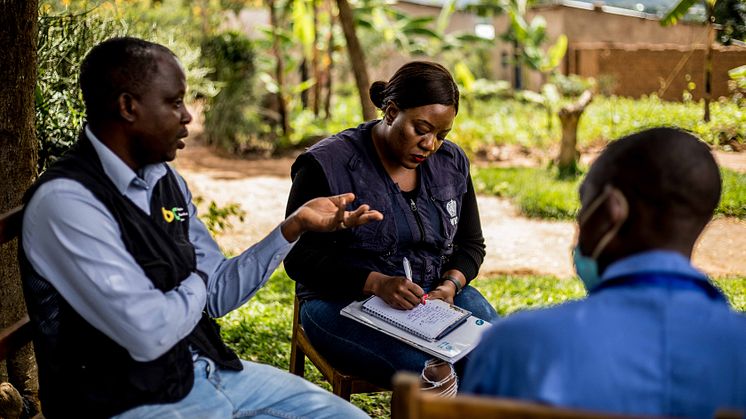
Overall, the report draws on innovative and participatory measurement approaches to highlight examples that capture not just volunteer numbers and hours, but also the less tangible effects such as trust, collaboration, personal growth and community solidarity.
The SWVR 2026 concludes with key recommendations for different interest groups involved in volunteer measurement – from policymakers and governments to global organisations – emphasising the need for inclusive, context-specific and mixed-methods approaches that balance international frameworks with locally grounded insights.
Northumbria University academics have developed a leading hub of research expertise, knowledge exchange and learning on volunteering in humanitarian crises and development contexts. Their work is supported through significant funding from UK research councils, leading global humanitarian agencies and NGOs in the UK and internationally.
Topics
Categories
UNIVERSITY OF THE YEAR 2022 (Times Higher Education Awards)
Northumbria is a research-intensive university that unlocks potential for all, changing lives regionally, nationally and internationally.
Two thirds of Northumbria's undergraduate students come from the North East region and go into employment in the region when they graduate, demonstrating Northumbria's significant contribution to social mobility and levelling up in the North East of England.
Find out more about us at www.northumbria.ac.uk
--- Please contact media.communications@northumbria.ac.uk with any media enquiries or interview requests ---