Press release —
Rare Norman Cornish painting donated to Northumbria University
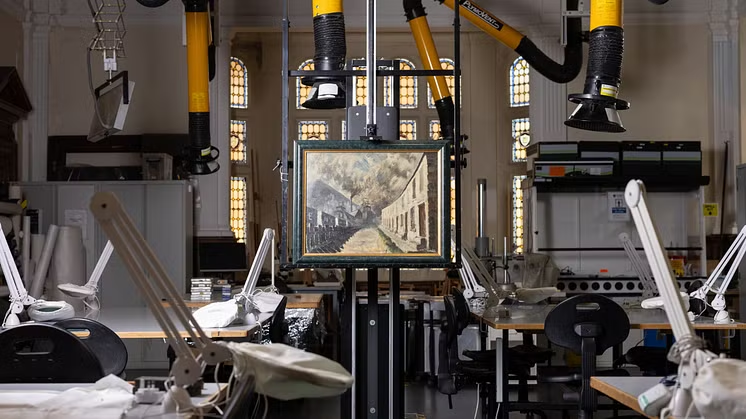
A rare early painting by celebrated North East artist Norman Cornish has been donated to Northumbria University, adding a significant new work to one of the most important collections of Cornish's work in the world.
The painting, Colliery Row, was created in 1947, early in Cornish's career while he was still working as a miner at Dean & Chapter Colliery Ferryhill, and beginning to sketch and paint through the Spennymoor Settlement Sketching Club, which he joined at the age of 16.
It is the earliest work now held in the university's collection and the only one from this formative period, offering a rare window into Cornish's development before he left mining to become a full-time artist.

The work was gifted to the University by Bryn Morris, a former employee of the British Coal Corporation, who purchased the painting as part of the disposal of British Coal's remaining art collection at the end of 1997.
Northumbria has a long-standing connection to Cornish and his work. The university's gallery represented him and displayed his work from 1989 onward.
In thanks for this relationship, Cornish and his wife Sarah gifted eight works to the university in 1991, with two further paintings added by his estate following his death in 2014.
The university holds the Norman Cornish Archive, comprising of the artist’s correspondence, painting materials, interviews and other archival matter and possesses the largest single collection of Cornish’s paintings and works on paper in the world.

The new acquisition comes as more than 50 of Cornish's sketchbooks, drawn from the university's collection, are on loan to The Bowes Museum for the exhibition Norman Cornish: A Life in Sketchbooks, which runs until 3 January 2027.
Speaking about the donation of Colliery Row, on behalf of the Norman Cornish Estate, Mike Thornton said: “This is a wonderful and rare addition to the permanent collection at Northumbria University. Colliery Row was an early work by Norman Cornish, and the acquisition helps to fill a gap in the back catalogue of works during his early development towards social realism.”
Colliery Row has a striking history. It is believed to be one of five paintings acquired directly from Cornish by Dr R W Revans, then Director of Education for the National Coal Board, who saw the work at one of Cornish's early exhibitions at The Spennymoor Settlement. Colliery Row was located at Trimdon, County Durham, near the home of his future wife Sarah Bartley.
The paintings became part of the National Coal Board's own art collection, displayed at the organisation's headquarters, Hobart House, in London.
Dr Revans went on to organise the landmark Art by the Miner exhibition, held at the Academy Cinema on London's Oxford Street in October 1947 and opened by the then Prime Minister, Clement Attlee.

Cornish was invited to contribute seven works, including Colliery Row, and thanks to his earlier experience with the Spennymoor Settlement, was asked to hang the exhibition himself.
It was during this exhibition that Cornish gave his first live television interview, from the BBC's studios at Alexandra Palace, a moment now seen as pivotal in his emerging career as an artist.
Colliery Row remained in public ownership through the National Coal Board and its successor, British Coal, until the industry's privatisation.

Upon hearing about Northumbria University’s relationship with Cornish, Mr Morris decided the painting should return to its original home in the North East.
He said: “Given the North East connection and the fact that the University of Northumbria holds a collection of works by Norman Cornish, including the permanent loan of his papers from the Cornish family, I decided that Northumbria University would be a fitting home and reliable custodian of this important work of art and piece of North East social history.”
Academics and students at Northumbria will now carry out a full technical study of the newly donated painting, beginning with a visual condition assessment before moving to imaging techniques such as X-ray, ultraviolet and infrared photography, and eventually chemical analysis of the paint and materials used.
Cornish is known to have often worked on inexpensive, readily available materials such as hardboard, which can present particular conservation challenges.
The project will showcase Northumbria's art conservation facilities, unique in the North East, ahead of the programme's 60th anniversary in 2027.

Dr Richard Mulholland teaches on Northumbria’s Conservation of Fine Art MA programme, as well as managing the University Art Collection. He said: “This painting is a remarkable addition to our collection. We hold one of the most significant Norman Cornish collections in the world, but until now we've had nothing from this very early period, while he was still working as a miner.
“Being able to examine the painting in detail, using techniques from a simple visual examination of its condition right through to technical imaging using ultraviolet and infrared photography, x-radiography and scientific analysis of its materials, will let our students and researchers learn directly from the physical object itself, not just the stories that have been told about Cornish's life."

PhD student Jennifer Myers will be carrying out scientific analysis on Colliery Row as part of her research into Cornish’s work. She said: “What excites me most about this painting is that it comes from such an early point in Cornish's career, before he left mining to focus on art full-time.
“My research looks at his materials and development as an artist, and the university's archive is an extraordinary resource for that, sketchbooks, letters, and finished paintings that document his relationships with other artists and his choices of materials.
“This painting gives us a rare chance to study an artwork which may provide more clues about the detail of Cornish’s working practice during that transition."
Find out more about Northumbria University’s Conservation of Fine Art MA courses – Works of Art on Paper, and Easel Paintings.
Topics
Regions
UNIVERSITY OF THE YEAR (Times Higher Education Awards, 2022)
RESEARCH UNIVERSITY OF THE YEAR (Daily Mail University Guide, 2024)
MODERN UNIVERSITY OF THE YEAR (Daily Mail University Guide, 2024 and The Times and Sunday Times Good University Guide, 2025).
Northumbria is a research-intensive university that unlocks potential for all, changing lives regionally, nationally and internationally.
Two thirds of Northumbria's undergraduate students come from the North East region and go into employment in the region when they graduate, demonstrating Northumbria's significant contribution to social mobility and levelling up in the North East of England.
Find out more at www.northumbria.ac.uk
--- Contact media.communications@northumbria.ac.uk with any media enquiries or interview requests ---